

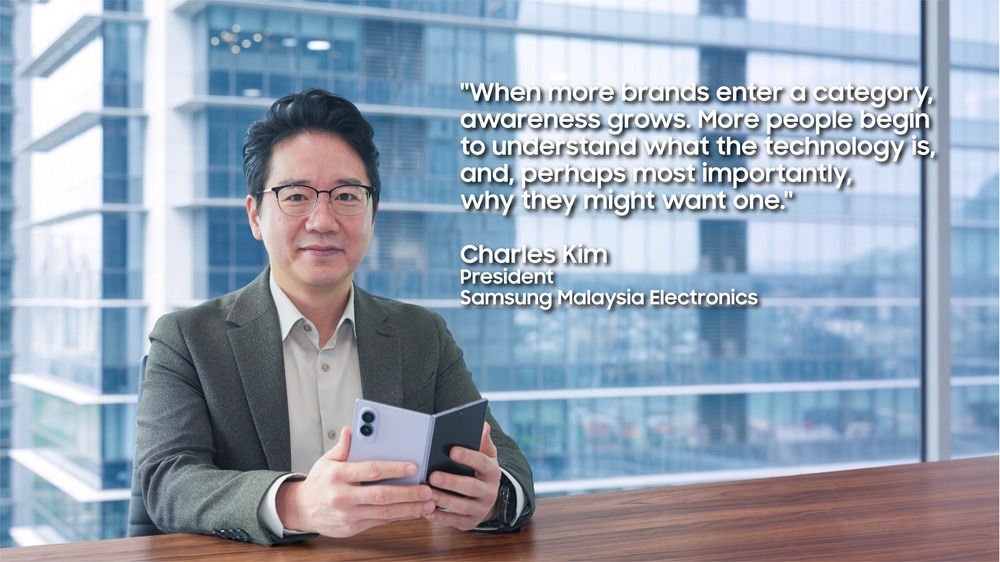
By Charles Kim, President of Samsung Malaysia Electronics
Foldable smartphones were often thought of as not much more than a niche category. That was years ago. This year, we are seeing a drastic change.
As more major technology brands enter the foldables scene, the sentiment should not be apprehension. In fact, for Samsung, which introduced its first Galaxy Fold in 2019, I see it is a sign that an idea we had early on is becoming increasingly relevant to the wider mobile industry.
This is good news, because as more brands enter a category, awareness grows. More people begin to understand what foldable technology is, what it can do, and perhaps most importantly, why they might want one.
The shift from “Does a phone fold?” to “Why do I need a foldable?”
The future of foldables should be about letting people decide for themselves why a foldable phone makes sense for the way they live.
For some, it may be about having a larger canvas such as the Galaxy Z Fold8’s 4:3 screen for watching, reading or gaming with the convenience of folding that canvas into a pocketable form factor. For others, it may be about productivity and multitasking on an all-in-one device like the Galaxy Z Fold8 Ultra. It could also be the compactness of a flip phone like the Galaxy Z Flip8, or simply having a device that enables new ways to create content.
We are now witnessing a transition with foldables moving from something people noticed to something people actually consider for themselves.
From curiosity to consideration
Malaysia is a particularly interesting market in this regard.
The latest national data on information and communications technology shows that mobile phone usage among individuals reached 99.6% in 2025, while internet usage reached 98.3%. Malaysians are already deeply accustomed to using mobile technology across work, entertainment, communication and everyday life.
When virtually everyone is already carrying a smartphone, it creates an important opportunity for new form factors, and raises the question of whether a different kind of phone can meaningfully improve the way someone uses it.
We have seen this evolution in our own consumer market insights. Samsung’s 2024 post-launch research across Southeast Asia and Oceania, including 300 Malaysian respondents, found strong purchase interest in the Galaxy Z series among younger consumers, particularly Millennials and Gen Z, with foldables being associated with productivity, creativity and photography.
That is a great takeaway – people do not perceive foldables as technological curiosities anymore. They are beginning to really consider what foldables can do for their lives.
With more brands entering the category, that consideration will become even more common.
Competition raises the bar
Foldables make for an unusually complex engineering challenge. Making a screen fold is only the first step. The industry has to continually address durability, weight, hinges, software, displays and the fundamental question of how a changing form should change the experience. All this, while not forgetting to advance key features users value in any smartphone, regardless of its form factor, such as battery capacity and camera capabilities.
While Samsung has been spearheading foldable technology for several years, competition is exactly what I consider essential to push us to learn and improve with every generation of the Z series.
Our first Galaxy Fold weighed 276 grams. Galaxy Z Fold8 now weighs 201 grams, making it Samsung’s lightest fold yet, and it also introduced a new form factor while advancing the display, hinge and internal architecture. With Galaxy Z Fold8, Fold8 Ultra and Flip8, we have also expanded the proposition beyond a single definition of what a foldable should be. One is designed around immersive discovery, another around maximum productivity and content creation, and another around compactness and self-expression.
That progress and the rationale behind the Galaxy Z series happened because consumers told us, directly and indirectly, what would make foldables more useful in everyday life.
The consumer will decide what comes next
This is where I believe competition truly ramps things up for the industry. As more consumers encounter different approaches to foldable design and how it fits their needs, they will become more informed. They will ask better questions.
Is a foldable useful? Does it help me work? Does it fit into my daily routine? Is it durable enough? Does its size and shape actually make a difference? These are some of the questions that will determine the category’s future.
We are already seeing signs of this shift in Malaysia and across our region. Less than a month after the latest Galaxy Z8 series was unveiled at Unpacked, the series recorded strong demand across Southeast Asia and Oceania, with Galaxy Z Fold8 and Fold8 Ultra pre-orders growing by approximately 60% compared with the previous generation. Samsung also saw an increase of more than 60% in switchers from other brands to the latest Fold generation.
These figures are encouraging, and I see them as evidence of a broader change in consumer behavior. We were once astounded by the advent of thin, touchscreen smartphones after a long era of tactile numeric keypads. With every big successful change, the world adapted to these inventions – every time, people embraced the new norm.
And now, people are again becoming more comfortable with the idea that a smartphone does not necessarily have to look the way it has looked for the past decade.
A bigger category creates a bigger responsibility
For Samsung, being the pioneer in foldables has never meant that we expect to be the only ones in the conversation. A thriving product category still needs different ideas, different approaches and different perspectives. When more companies challenge established assumptions, engineers have more problems to solve, designers have more possibilities to explore, developers have more reasons to rethink how software should work with hardware.
And in the end, consumers benefit.
After seven generations of Galaxy Z innovation, and now into our eighth generation, we have accumulated years of learning about what people value and what still needs to improve. We will continue to invest, listen, learn and innovate – not because competition has arrived, but because competition gives the entire industry a reason to push further.
It also makes our responsibility greater.
I believe this next chapter will be an exciting one. The foldable story is no longer about proving that a smartphone can fold. It is about discovering what else becomes possible when it does. And I believe we are only beginning to find out.