

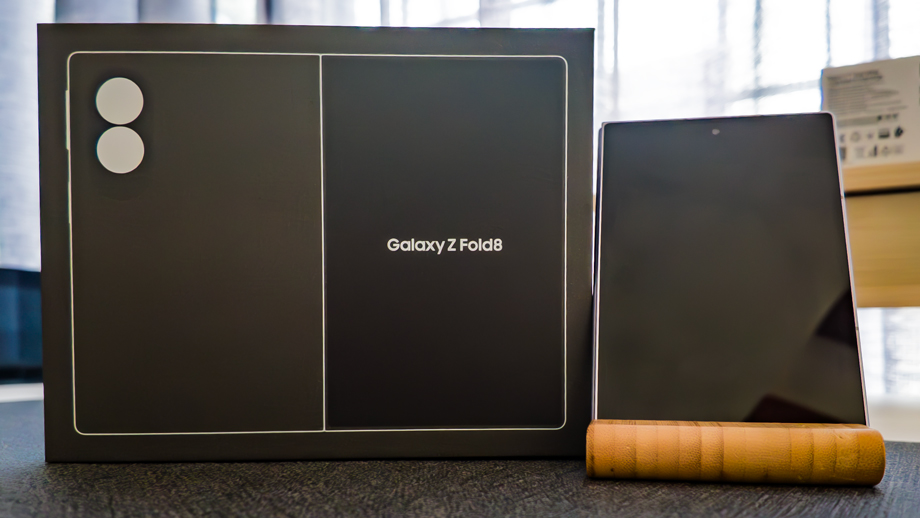
The Samsung Galaxy Z Fold 8 is one of those phones that doesn’t need a gimmick to convince you it’s special. It’s built for people who want a device that can be a normal phone one second and a small tablet the next, without feeling like a compromise either way.

This is Samsung’s most refined take on the Fold formula yet. Previous generations always felt like they were negotiating between “phone” and “tablet,” picking one identity at the expense of the other. The Fold 8 stops negotiating. The result is a foldable that finally feels like it was designed around how people actually use their phones, not around what looks impressive in a keynote.

Design & Build
Pick this thing up and the first thing you notice is how much lighter it feels. At 201 grams, it’s the lightest Z Fold Samsung has made, and closed up it measures a wallet friendly 123.9 x 81.9 x 9.7mm. Unfolded, it opens into a 161.4 x 123.9 x 4.5mm slab that’s barely thicker than a standard flagship.
Samsung also finally tackled the crease. The new Flex Titanium hinge makes it far less visible and far less noticeable under your thumb, which is the kind of detail that matters way more in daily use than in a spec sheet.

It’s not just about looking sleek either. You still get IP48 dust and water resistance, along with Gorilla Glass Ceramic 3 up front and Gorilla Glass Victus 2 on the back. It doesn’t scream “fragile experiment,” it feels like a phone built to survive actually being a phone.
Specifications
| Dimensions | Unfolded : 161.4 x 123.9 x 4.5 mm Folded : 81.9 x 123.9 x 9.7 mm |
| Weight | 201 g |
| Display Type | Inner : Foldable Dynamic LTPO AMOLED 2X, 120HZ Outer : Dynamic LTPO AMOLED 2X, 120Hz, |
| Display Size | Inner : 7.6 inches Outer : 5.5 inches |
| OS | Android 17, ONE UI 9 |
| Chipset | Snapdragon 8 Elite Gen 5 |
| Memory | 256GB 12GB RAM, 512GB 12GB RAM, 1TB 12GB RAM, 1TB 16GB RAM |
| Rear Camera | 50 MP, f/1.8, 23mm (wide), 1/1.56″, 1.0µm, dual pixel PDAF, OIS
50 MP, f/1.9, 13mm, 120˚ (ultrawide), 1/2.51″, 0.7µm, multi directional PDAF |
| Front Camera | Inner : 10 MP, f/2.2, 18mm (ultrawide) Outer : 10 MP, f/2.2, 24mm (wide) |
| Speakers | Stereo Speakers |
| Battery Type | 4800 mAh Silicon Carbon |
| Charging Speed | 45W wired
20W wireless 4.5W reverse wireless |
Display
This is where the Fold 8 makes its biggest leap. The old Fold displays were tall, narrow, and a little awkward, great for scrolling, kind of a mess for anything widescreen. Samsung fixed that by rethinking both screens from scratch.
The cover display switched to a wider 16:10 ratio, so it’s now genuinely usable for video and full apps instead of just quick glances. Unfold it, and the main display’s new 4:3 ratio turns it into something closer to a small tablet, cutting down on the letterboxing that made watching video on older Folds feel cramped.

Peak brightness hits 3,000 nits, so outdoor visibility isn’t the struggle it used to be on this line, and the 120Hz refresh rate keeps everything feeling smooth whether you’re gaming or just scrolling.
Performance
The Snapdragon 8 Elite Gen 5 for Galaxy is the same silicon powering this year’s top tier Galaxy phones, and it shows. Multitasking across split screen apps, running demanding games, or jumping between the cover and main displays all feels effortless, with no real hitches even when you’re pushing it.
This is a proper generational jump over last year’s Fold, not just a marginal refresh. Combined with either 12GB or 16GB of RAM depending on configuration, there’s enough headroom here that this phone should stay snappy well past its first year.

Multitasking
Multitasking, specifically, is where the Fold 8 earns its keep. One UI 9 doesn’t just let you run two apps side by side, it lets you run three at once on the unfolded display, with the option to arrange them however makes sense: one app dominant with two narrower ones flanking it, or an even three way split. Pull down the taskbar and you can drag apps straight into a layout instead of hunting through the app drawer, and frequently used combinations (say, a browser and Notes, or Mail and Calendar) can be saved as App Pairs and launched together with a single tap.
Power users get a couple of gestures worth turning on right away: a two finger swipe from the edge drops an app into split screen instantly, while swiping in from the top corner turns any app into a freely resizable pop up window you can drag around on top of everything else. Samsung DeX rounds it out, plug the Fold 8 into a monitor and it becomes a genuine desktop style interface with mouse and keyboard support, while the phone itself can keep showing something different.
In practice, this changes what the phone is actually for. A few scenarios where it stops feeling like a novelty and starts feeling useful:
- Research and writing – browser open on one side, Notes or Docs on the other, with a PDF pinned in a pop up window for reference. No app switching, no losing your place.
- Travel – Maps and Messages side by side, so you’re never toggling away from directions to reply to someone.
- Quick desk work – DeX turns the Fold 8 into a lightweight laptop replacement for email, docs, and browsing when you don’t want to carry a second device.
- Content consumption – the wider cover screen and 4:3 main display mean video, comics, and long form reading finally look intentional instead of stretched or letterboxed.
None of this is unique to the Fold 8 on paper, Samsung’s had multi window tricks for years, but the combination of a genuinely usable 4:3 main display, a taskbar that behaves like a real OS feature, and hardware fast enough to not choke on three open apps is what makes it click this time around.
Battery & Charging

The 4,800mAh silicon carbon battery is a sensible size for a phone this thin, and it’s split across both halves of the hinge to keep weight balanced. Charging tops out at 45W wired and 20W wireless, which isn’t class leading, but it’s dependable and gets the job done without babying the battery.
Given that Samsung moved to silicon carbon cell chemistry here, there’s a reasonable case that they could’ve pushed capacity even further. It’s a small nitpick rather than a dealbreaker.
Cameras

The 50MP main and 50MP ultrawide combo is solid, not spectacular. Photos look clean in good lighting, colors are accurate, and everyday shots come out exactly how you’d want them to. The absence of a telephoto lens is the clearest sign that Samsung prioritized thinness and weight over a maxed out camera bump, and for most people that’ll be a fair trade.
Sample Images


Final Thoughts

The Galaxy Z Fold 8 isn’t trying to reinvent the foldable, it’s trying to finally get it right. Lighter build, a crease that’s actually hard to notice, a display setup that works for video instead of fighting it, and flagship performance to back it all up.
It’s still a RM7699 phone for the 512GB variant(256GB is RM7099), so this isn’t an impulse buy. But if you’ve been waiting for a foldable that doesn’t feel like an early adopter tax, this is the one. Light. Balanced. And finally, comfortable in its own shape.